

Kevin Warsh and the Fed will announce their latest rate decision this afternoon in about 20 minutes.
They might raise a bit to try to nip inflation which is now 3-4%. Or they might hold to make Trump happy and help with midterms. We don’t know. Markets expect a quarter-point hike because inflation is running a little hot.
A Fed hike raises short-term rates, but long-term rates can still fall. If the market thinks the hike will cool inflation, today’s long-term yields look more attractive in real terms, so investors buy long bonds. That pushes long bond prices up and yields down.
Lots of moving parts that can change that, but generally the thesis here would be: if there’s a hike, long bond prices go up.
TLT is near the bottom of it’s long-term range. Same with EDV. Same with TMF.
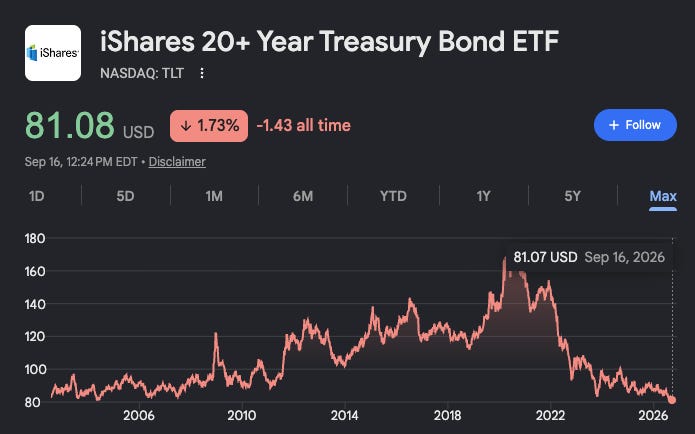
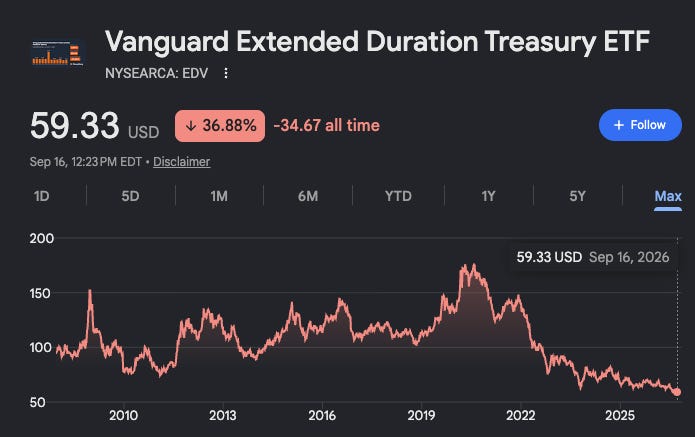
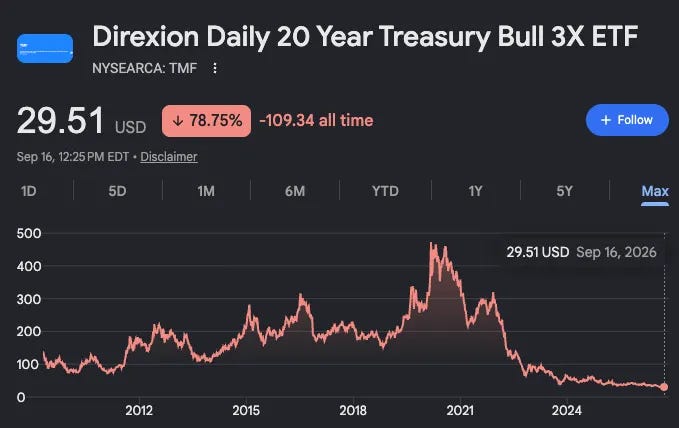
Assuming long-term yields fall about 1 percentage point over the next year, here are trades I’m thinking about.
TLT. Rates fall, long bonds rise. A 1% drop in yields could mean roughly a 15% gain, turning $10,000 into about $11,500.
EDV. More sensitive to rate moves. The same decline in rates could mean something closer to a 20–25% return, or roughly $12,000–$12,500 on $10,000.
TMF. Targets 3x the daily move in long Treasuries. If the bond rally is strong and fairly smooth, $10,000 could plausibly become $14,000–$15,000+. But because the leverage in this fund resets daily, if rates bounce around before falling, the return can be much worse.
TLT calls. Probably provides the most leverage, but they add a shot clock to the trade. A well-chosen long-dated call could potentially turn $10,000 into $20,000 or more if TLT moves enough. It could also go to zero if the move comes too late.
Disclaimer
This piece is for informational purposes only. You should not construe anything herein as investment, financial, legal, tax, or other advice. Nothing contained in this piece constitutes a solicitation, recommendation, endorsement, or offer to buy or sell any securities or other financial instruments.
All content in this piece is for general informational purposes only and does not address the circumstances of any particular reader. Nothing in this piece constitutes professional and/or financial advice, nor does it constitute a comprehensive or complete statement of the matters discussed. You alone assume the sole responsibility of evaluating the merits and risks associated with the use of any information or other content in this piece before making any decisions based on such information or other content. Neither the author nor any of its affiliates accepts any liability whatsoever for any direct or consequential loss howsoever arising, directly or indirectly, from any use of the information contained herein.